Retro 4th of July Illustration in Real-World Design Workflows
When a project calls for a vintage Americana feel, a well-crafted Retro 4th of July Illustration serves as more than decoration. It operates as a functional visual building block that integrates into broader creative processes, from initial concept drafts to final published media. This asset category combines nostalgic motifs—distressed textures, muted reds, faded blues, classic stars and stripes—with the flexibility required by modern digital and print design pipelines. Understanding its structure, file formats, and editability helps teams and solo creators move faster without sacrificing visual coherence.
What Defines a Practical Retro Illustration Set
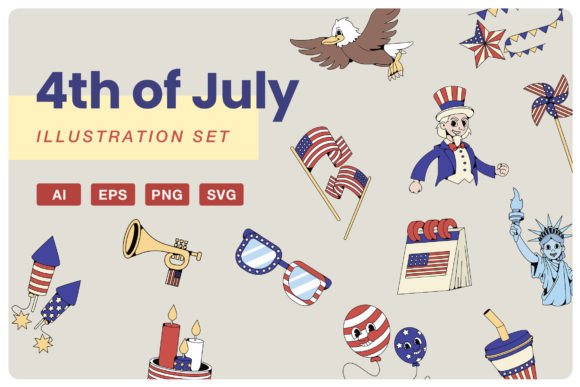
Not every illustration labeled “retro” delivers the same production value. A focused set built around Independence Day iconography typically includes stylized flags, fireworks, bunting, eagles, banners, typographic elements, and symbolic objects like liberty bells or shields. The defining characteristic is a hand-drawn or vintage print aesthetic that feels aged and authentic, avoiding overly polished digital sleekness. In this context, a Retro 4th of July Illustration bundle ships with multiple file versions—commonly AI, EPS, SVG, and high-resolution PNG—so it can be dragged into your existing stack without conversion friction. The vector foundation at 2000×2000 pixels ensures scalability, making the same graphic work on a mobile app splash screen, a presentation slide, a printed banner, or an infographic without loss of quality.
Where This Illustration Style Integrates Into Your Project Pipeline
These assets are rarely stand-alone. They become part of a larger narrative: a summer sale campaign, a community event flyer, an annual report with seasonal data callouts, or even educational materials that reference U.S. history. Identifying insertion points early saves revision time. For website design, retro illustrations can anchor hero sections, blog post headers, or sidebar widgets during a holiday refresh. In mobile apps, they act as onboarding screens, event countdown badges, or notification illustrations. Presentations benefit from thematic slide backgrounds and data visualization accents, while analytical reports and infographics use them to break monotony and guide the reader’s eye. By treating a Retro 4th of July Illustration set as a modular toolkit, you reduce the need to commission custom art for each asset, which is especially helpful for small business owners and independent publishers planning ahead.
Website and Landing Page Implementation
During a limited-time Independence Day promotion, swapping generic hero images for a cohesive vintage look can reinforce brand personality. Since the files include editable AI and SVG formats, you can isolate individual icons from a larger illustration and place them around calls-to-action or testimonial sections. The 2000×2000 px canvas provides enough real estate to crop into banner-shaped dimensions without upscaling. Keeping a master document with all elements organized on separate artboards makes it easy to export web-optimized PNGs in bulk. This approach aligns with a common workflow: prepare the base design once, then duplicate and adjust for each platform, from desktop headers to mobile-responsive breakpoints.
Presentation and Report Graphics
Educators, analysts, and corporate communicators often need to inject visual interest into data-heavy decks without distracting from the message. A Retro 4th of July Illustration can be deconstructed in Illustrator or even in open-source tools like Inkscape to pull out a single firework burst or a subtle striped border. Placed in the corner of a slide, it sets a seasonal tone while keeping charts and tables legible. Because the color palette is editable, you can desaturate the reds and blues to match a subdued corporate template or crank up vibrance for a community event recap. The vector nature means the graphic scales perfectly when projected on large screens, avoiding the pixelation that plagues raster images lifted from stock sites.
Infographics and Data Storytelling
Infographics thrive on a balance between information density and visual flow. Retro illustrations work as section dividers, icon replacements, or background textures that evoke a bygone era. For instance, a horizontal timeline of American innovation can use vintage-styled milestone markers. With an editable Retro 4th of July Illustration set, you can extract individual stars to serve as bullet points or rating indicators, maintaining thematic consistency. The provided EPS and AI files enable advanced users to release compound paths, recolor objects, and rearrange compositions without starting from scratch. This efficiency matters when you are producing a series of infographics for a multi-channel campaign, because it preserves a unified look across email, social, and blog content.
File Format Choices and Cross-Platform Compatibility
The inclusion of multiple file formats directly impacts how the asset moves through a production environment. An AI file gives full access to layers, groups, and editable paths in Adobe Illustrator—ideal for designers who need to extract, modify, or combine elements. EPS serves as a legacy vector exchange format that works across decades-old publishing tools and plotters. SVG is the web-native vector standard, ready to be dropped into website code, React components, or Figma projects without rasterization. High-resolution PNG files provide quick, no-setup solutions for non-designers who simply need to paste an image into a Google Slides deck or Canva board. Each format reduces a specific friction point, whether it’s a developer needing inline SVG for animation or a marketer who wants a transparent background for a social post. By having all variants in one bundle, you avoid the back-and-forth of requesting a different export from a freelancer.
Editing Without Breaking Consistency
One underrated benefit of a well-structured Retro 4th of July Illustration set is editable color. Instead of receiving a flat, locked image, you get artwork where global swatches or easily selectable fills let you adapt the patriotic palette to brand guidelines. For example, a food brand running a Fourth of July promotion might need to replace standard navy with its own dark blue and mute the reds. This can be done in seconds by updating swatch definitions in Illustrator, which cascades through all linked objects. The same principle applies to resizing: vector shape integrity holds at any dimension, so a single badge designed at 2000×2000 px can be reduced to a website favicon or enlarged to a store window decal without jagged edges. When you plan for long-term reuse, create a color-variant sheet—save a base version, then make a palette-swapped copy for each brand or campaign, all sourced from the same master file.
Organizing Assets for Efficiency and Reusability
After downloading a bundle, a brief organizational routine pays dividends over time. Unpack the contents into a clearly labeled folder hierarchy: one directory for editable source files (AI, EPS), one for web-ready SVGs, and one for raster exports (PNGs at 1x and possibly 2x resolutions). Naming conventions like retro-fireworks-single.svg or star-banner-blue.png make them searchable when you’re assembling a design months later. For teams, storing these in a shared cloud library—such as Creative Cloud Libraries, Figma team files, or a dedicated brand asset folder in Google Drive—lets everyone pull the same approved version. This reduces the risk of someone downloading a low-res copy from a search engine and diluting brand quality. A Retro 4th of July Illustration becomes a reusable module rather than a one-off decoration, saving hours in future years when the holiday cycle returns.
Collaboration and Handoff Scenarios
In a typical workflow, a designer prepares the initial layout with vector illustrations, then hands it off to a developer or content publisher. Providing an SVG sprite sheet or optimized individual SVGs prevents the developer from opening Illustrator or wrestling with export settings. The SVG format is text-based, so a developer can quickly tweak a hex code in the code editor to match brand guidelines, or embed it directly into an email template. When the asset set includes transparent PNGs at high resolution, a social media manager can schedule posts without needing design software. This kind of cross-role compatibility removes the usual “design bottleneck” and allows content to go live faster, which is critical when capitalizing on a short-term event like Independence Day.
Quality Control Across End Uses
Because retro illustrations often feature distressed textures and subtle gradients, it’s important to test how they render in different environments. A texture that looks great on screen may become muddy when printed on a low-resolution banner. Before finalizing, review the PNG files at 100% zoom to check for artifacts. For print, use the AI or EPS file directly in your layout software, ensuring that overprint settings and spot colors (if any) are interpreted correctly. If you are building a website, test the SVG rendering in Firefox, Chrome, and Safari, as browser engines sometimes handle fine details differently. A quick cross-browser check can reveal faint lines that disappear or thicken unexpectedly. These small verification steps ensure that a Retro 4th of July Illustration maintains its character from a smartphone screen to a large-format flyer.
Planning Campaign Sequences Around a Cohesive Visual Theme
Marketers and entrepreneurs often batch-create content weeks before a holiday. Using a single retro illustration set as the creative backbone allows you to produce a sequence of visuals: a teaser post, an announcement graphic, a countdown story template, an “about the holiday” infographic, and a thank-you email. Because the elements are vector-based and editable, you can animate a flag waving in an Instagram story by slightly rotating and re-exporting frames, or create a looping GIF from firework bursts. The process becomes modular: select components, arrange them in a canvas specific to each platform, apply consistent color treatments, and export. Having a cohernt Retro 4th of July Illustration library at the start gives you the flexibility to pivot if a new marketing channel becomes relevant mid-campaign, without scrambling for art.
Long-Term Value and Adaptability Beyond the Holiday
While the primary season is clear, these assets can support projects that reference nostalgia, Americana, or historical periods. A small business blog about heritage craftsmanship, a nonprofit’s patriotism-themed fundraising drive, or an educator’s lesson on the American Revolution can all repurpose elements from the set outside July. By keeping the editable source files, you can remove explicit date references, alter typography, or mute the palette to fit a more subdued vintage aesthetic. This extended lifespan increases the return on investment for the asset. Rather than being a single-use download, a Retro 4th of July Illustration collection evolves into a mini design system for any project that benefits from a warm, old-fashioned tone. When you frame an asset purchase or download in terms of long-term reusability and process integration, you shift from ad-hoc decorating to strategic visual design, and that mindset change shows in the finished work.